
The project is co-financed by the governments of Czechia, Hungary, Poland and Slovakia through Visegrad Grants from the International Visegrad Fund. The mission of the fund is to advance ideas for sustainable regional cooperation in Central Europe.
The Slovak Electric Vehicle Association (SEVA), together with the Polish new mobility association PSNM and Hungary’s ZONE Cluster, is launching V4SDV Connect. The project supports the development of the three countries’ ecosystem for the European agenda on software-defined and autonomous vehicles. It runs from September 2026 to February 2027 with the support of the International Visegrad Fund.

Why we are taking this on
The automotive industry is going through a three-layer transformation in which each layer reinforces the others: the electric platform provides the hardware base, the software-defined architecture acts as the digital brain, and vehicle autonomy is the application layer. A software-defined vehicle is run by a handful of powerful computers, new functions arrive over the internet years after it leaves the line, and autonomous driving is built on that layer. Value in the automotive industry is shifting from the combustion engine to the electric drivetrain, and from hardware to software, data and digital services.
For Slovakia, Poland and Hungary, which built a large part of their economies on making cars, this is a decisive issue. So far, though, the players in these countries work out the European rules on artificial intelligence, type approval, access to in-vehicle data and cybersecurity on their own, and in European initiatives such as the ECAVA alliance the region’s voice carries little weight. There is no platform where companies, ministries and researchers from the three countries sit down together.

Who runs the project
The project is led by SEVA, which brings together companies across the automotive, charging and energy sectors as well as services and software. Its partners are PSNM, Europe’s second-largest new mobility organisation with more than 250 members and host of the New Mobility Congress in Katowice, and ZONE Cluster, a Hungarian innovation cluster for smart and autonomous mobility with a direct link to the ZalaZone proving ground.
In their own countries, all three organisations connect industry with ministries and research, which allows the project to bring together the people who can genuinely move the topic forward.
What the project delivers
A comparison of legislation and standards across the three countries. A joint map will place Slovakia, Poland and Hungary side by side across five areas: artificial intelligence in mobility, vehicle type approval, in-vehicle data and the Data Act, automotive cybersecurity, and connected and automated mobility. For each area the map will record the current state, the gaps against European rules and the risks in transposition.
A roundtable with ministries and industry in Bratislava. Representatives of ministries, the automotive sector and suppliers, technology companies, municipalities and academics from all three countries. The programme will focus on three blocks: regulation, industrial transformation and the region’s position in the EU.
A panel at the New Mobility Congress in Katowice. A discussion with representatives of ministries and industry from Slovakia, Poland and Hungary on the region’s readiness for software-defined and autonomous vehicles, within the largest sustainable mobility event in Central and Eastern Europe.
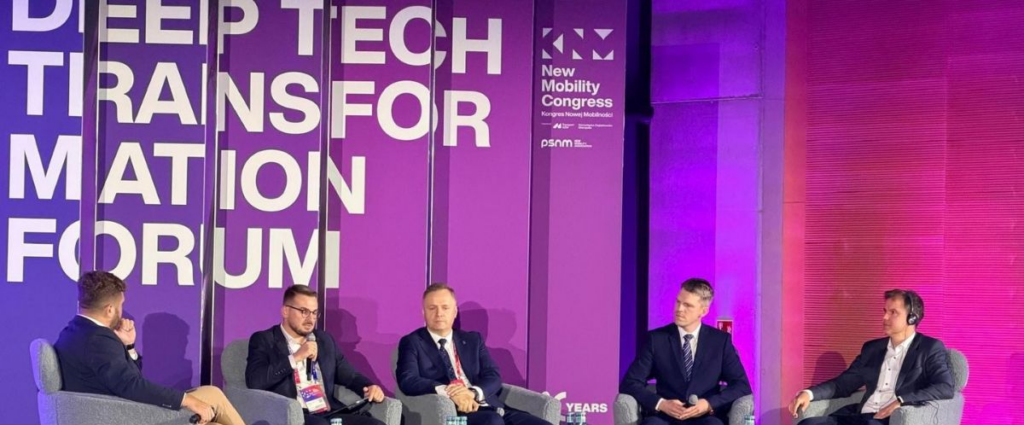
A panel at the CEE Automotive Transition Forum in Budapest. A public discussion on pilot projects, testing and regional partnerships, complementing the Katowice panel with a Hungarian perspective.
An expert visit to the ZalaZone proving ground. A study visit to one of Europe’s most advanced testing facilities for connected and autonomous vehicles and to the Budapest smart mobility ecosystem, including a working session on the regulation and type approval of autonomous vehicles.
Why it matters
A single shared position from three countries carries more weight in European standardisation and legislation than three separate national positions. V4SDV Connect is the first attempt to build this kind of cooperation around the digital transformation of the automotive industry. The legislative map and the relationships formed during the project can become an important basis for further activity in the region: for preparing European projects, for national strategies and for extending cooperation to other countries in the region.
The project can benefit ministries that transpose European rules into national law, carmakers and suppliers directly affected by the change, technology companies and startups, municipalities preparing for the operation of autonomous vehicles, universities and research institutions, and European institutions that need to understand this region’s position.
Follow the project
We will publish project outputs and summaries on this page throughout the project.
Contact: Patrik Križanský, Director of SEVA, info@seva.sk