
Value in the automotive industry is moving from combustion engines to electric drivetrains, from hardware to software, data and digital services. The automotive industry is therefore no longer undergoing a single change, but a three-layer transformation: the electric platform forms the hardware foundation, the software-defined architecture acts as the vehicle’s digital brain, and autonomy is the application layer built on top of this infrastructure.
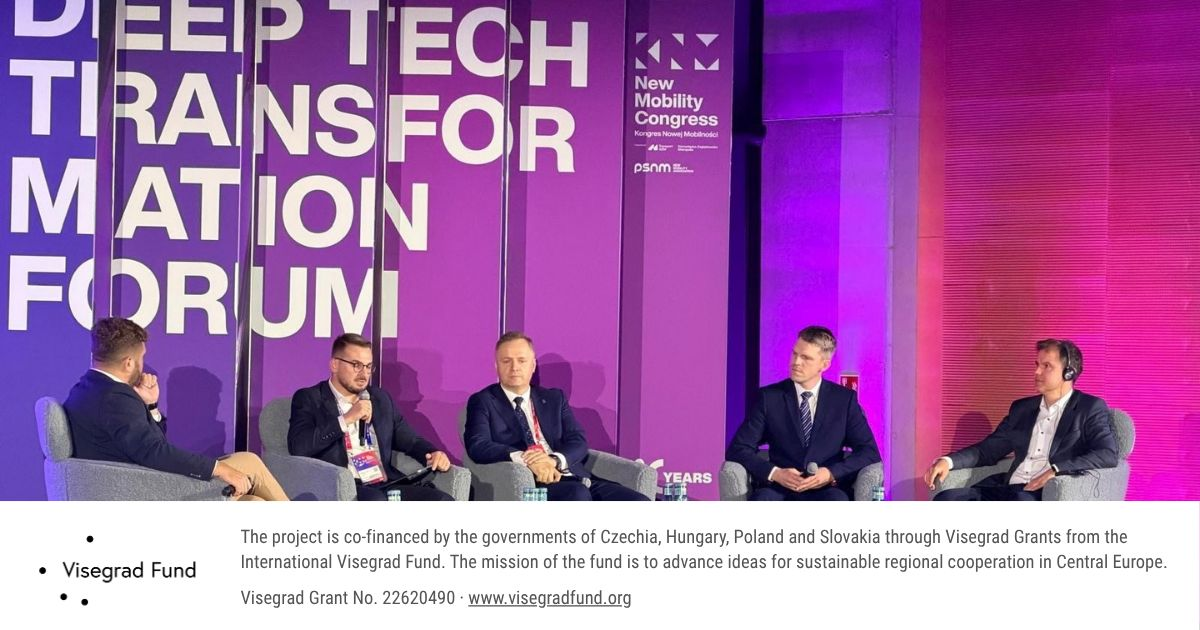
This was the focus of the panel Transport Automation and Autonomization — A Roadmap for the Market on the Deep Tech Stage at the New Mobility Congress in Katowice. It was also the first public activity of V4SDV Connect, a project implemented by SEVA together with the Polish association PSNM – We drive new mobility! and Hungary’s ZONE Cluster.
The discussion showed that Slovakia, Poland and Hungary are at three different stages of the same transition. Slovakia has adopted legislation for the commercial operation of driverless vehicles, Poland has a testing regime on public roads, and Hungary is developing practical Level 4 vehicle testing at ZalaZone. The region therefore has important pieces of the puzzle, but it still lacks a connected route that would turn these experiences into a shared regional capacity.
Europe is not short of legislation. An EU-level approval procedure for driverless vehicles has existed since 2022, yet according to the discussion there is still no publicly known vehicle approved under this framework. The problem is therefore not only between ambition and technology, but also between the legal framework, technical assessment, supervision, institutions and the vehicle itself.
One practical point from the discussion was that an autonomous vehicle is never truly “alone”. Even a driverless vehicle needs operational supervision, a control room and trained operators. The number of vehicles one operator can safely supervise may determine whether a robotaxi becomes a viable business model or remains only a very expensive alternative to a conventional taxi.
This is also why waiting until others have made the mistakes is not enough. Hardware may become cheaper, but institutional experience cannot be bought as technology. A country can buy a vehicle, but not a ready-made technical service, a regulator with real experience, a supervision system or trained operators. For a region that is one of the world’s major automotive centres in per-capita terms, waiting is also a strategic decision.
The purpose of V4SDV Connect is therefore to compare how Slovakia, Poland and Hungary respond to the European agenda on software-defined and autonomous vehicles. The output will be a joint map of legislation and standards in five areas: artificial intelligence in mobility, vehicle type approval, vehicle data and the Data Act, cybersecurity, and connected and automated transport. For each area, the project will capture the current state, gaps against European rules and risks in transposition.
The project will also include a roundtable with ministries and industry in Bratislava, further expert discussions at regional events, and an expert visit to the ZalaZone testing site and Budapest’s smart mobility ecosystem. The aim is to create a shared expert basis that can help the region in European projects, national strategies and coordination in legislation and standardisation.
V4SDV Connect is a project of SEVA, PSNM and ZONE Cluster, supported by the International Visegrad Fund. The project is co-financed by the governments of Czechia, Hungary, Poland and Slovakia through Visegrad Grants. The mission of the fund is to advance sustainable regional cooperation in Central Europe.
Visegrad Grant No. 22620490 · www.visegradfund.org