
Starting January 1, 2027, the rules for permitting charging infrastructure in Slovakia will change. For outdoor charging stations, the permitting process will no longer be based on power output, and the current 22 kW limit will be eliminated. This will significantly simplify, in particular, the construction of higher-power DC stations in existing parking lots. At the same time, requirements for charging infrastructure in buildings are changing, and the changes will also affect the permitting of charging points in apartment buildings.
The amendment to building regulations will resolve one of the main barriers that SEVA, together with charging network operators and other companies forming the electric mobility ecosystem in Slovakia, has long been highlighting. The previous permitting regime classified charging stations based on power output, even though in many cases this does not correspond to the scope of the construction work.
“A charging station’s power output alone is not a reason for a more complex permitting process. SEVA has addressed this issue with representatives from the business sector, local governments, and the state—for example, at a roundtable discussion with the APZD, the Ministry of Transport of the Slovak Republic, and the Presidium of the Fire and Rescue Corps. The scope of construction work should be the decisive factor in the permitting process. We therefore consider the removal of the 22 kW power threshold to be a significant simplification for the construction of charging infrastructure,” says SEVA Director Patrik Križanský, assessing the changes.
Why 22 kW specifically?
Under current rules, an outdoor charging station with a power output of up to 22 kW is classified as a minor structure. However, a higher power output is classified as a simple structure and requires a building permit decision, project review, and final inspection. This means that even a standard DC charger installed in an existing parking lot currently falls under this regime.
Starting in January 2027, power output will no longer determine the permitting regime. An outdoor charging station will be subject to a simple notification, regardless of whether its power output is 7.4 kW or 400 kW.
The practical difference is particularly significant for higher-power stations. For a high-power station in an existing parking lot that remains subject to the notification procedure, there will be no need for a building permit or final inspection—processes that can extend the timeline by up to three months—even though the actual installation of the technology takes considerably less time. “When building fast-charging stations today, it’s often not the construction itself that takes the longest, but the paperwork that follows. If the building permit application and final inspection are eliminated for a station in an existing parking lot, the investor can save months,” notes Patrik Križanský.
For small outdoor chargers, however, the amendment may paradoxically have the opposite effect. Stations up to 22 kW currently do not need to be reported at all under certain conditions. Under the new rules, outdoor stations will be subject to reporting regardless of their power output.
More Charging Stations at Office and Residential Buildings
Alongside the simplified permitting process, the requirements of the Building Energy Efficiency Act are changing. The obligations regarding charging are not entirely new, but the amendment modifies their scope as well as the requirements for preparatory work for future installation.
For new or significantly renovated non-residential buildings with more than five parking spaces, one charging point for electric vehicles will be required for every five parking spaces, along with cabling—i.e., cables already in place—for at least half of them. For the remaining parking spaces, wiring must be prepared.
The requirements are even stricter for office buildings. A new office building or an office building that has undergone a major renovation with more than five parking spaces must have one charging point for every two parking spaces.
“From the perspective of electric mobility, advance planning is particularly important. Retrofitting wiring in completed garages and parking lots is technically more complicated and more expensive. We need the building to be prepared for the gradual increase in the number of electric vehicles,” explains Patrik Križanský.
Wallbox in an Apartment Building: Unanimous Consent Is Not an Automatic Requirement
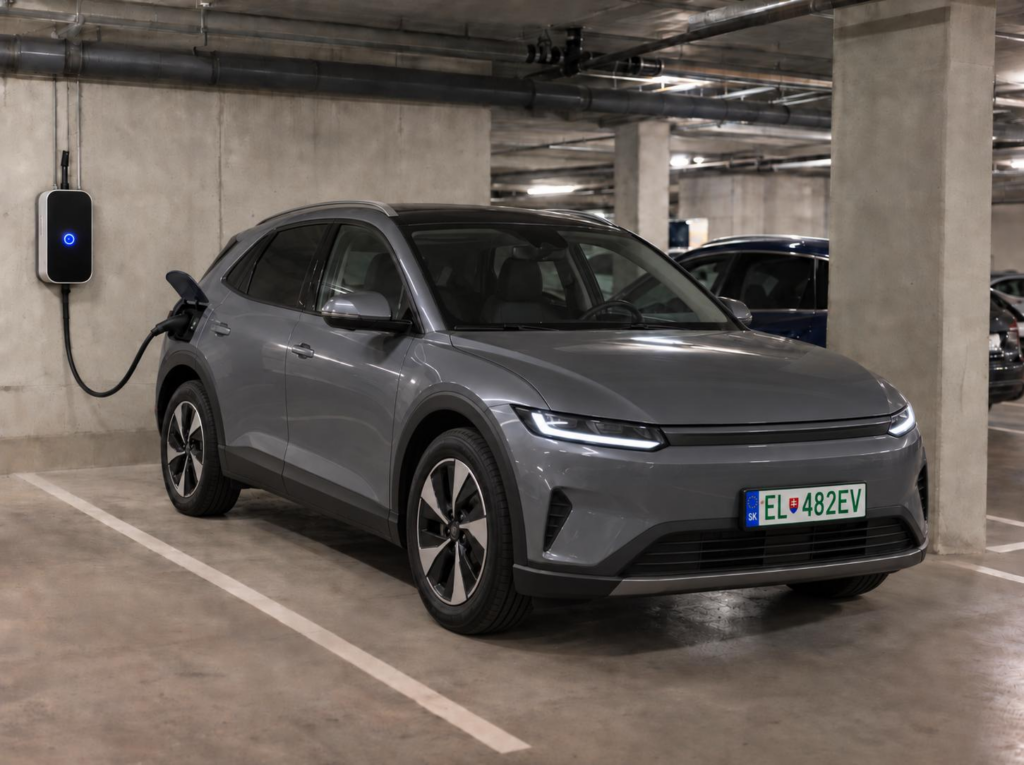
Charging in apartment buildings remains a special issue. When installing a wallbox, building codes, ownership relationships, and the capacity of the building’s electrical system all come into play. According to the interpretation of the Slovak Ministry of Transport, adding charging infrastructure to an existing building constitutes a structural modification and should be subject to notification. However, the amendment does not address indoor chargers in a separate provision; therefore, SEVA considers it necessary to confirm this interpretation through methodological guidelines from the Slovak Office for Spatial Planning and Construction.
“In apartment buildings, the wallbox technology itself is not the problem. Projects are complicated primarily by ownership relationships, shared utility lines, and available capacity. We therefore need a clear procedure that will be understandable to owners, property managers, and building authorities,” emphasizes Križanský. An important issue is the consent of the owners. According to SEVA’s interpretation, the law on apartment ownership does not automatically require the consent of all owners for the standard installation of a charging point.
According to SEVA’s interpretation, the law requires a simple majority of votes from all owners for structural modifications to common areas or common facilities of a building. If a new common facility is created—such as shared charging infrastructure—a two-thirds majority is required. The law requires the consent of all owners for other types of interventions, but this does not apply to the standard installation of a charging point. These rules regarding owner consent are already in effect today.
A simpler procedure does not mean less safety
A simpler permitting process does not mean a reduction in safety requirements. The notification does not replace obligations arising from fire safety regulations, technical standards, inspections, or conditions for connection to the distribution system.
It has not yet been confirmed whether state fire inspections will be waived for all charging stations operating under the notification system. The scope of supervision will also depend on the upcoming amendment to the implementing regulations of the Ministry of the Interior of the Slovak Republic. Even in cases without state fire supervision, the obligation to address fire safety in the project documentation remains.
SEVA will seek a uniform interpretation for building authorities
The amendment addresses the basic permitting regime, but several practical issues remain unresolved. These include, for example, the classification of certain outdoor stations, the assessment of indoor chargers, the definition of an associated transformer station, modifications to existing charging hubs, and certain situations in apartment buildings.
“The legislative change is an important step, but how it is applied in practice will be decisive. Investors need to know that the building authority will evaluate the same project in the same way in Bratislava, Košice, and in a smaller town. That is why we want to achieve the most consistent methodological interpretation possible before the new rules take effect,” concludes Patrik Križanský.
Details for SEVA members in the new Policy Update
SEVA has prepared a separate Policy Update for its members on the new legislation : Permitting of Charging Stations—What’s Changing as of January 1, 2027. This document goes into significantly greater depth than this public overview and includes specific expert analyses of individual project types, a decision matrix for permitting regimes, practical procedures, an explanation of obligations regarding buildings and apartment complexes, and an overview of issues that remain unresolved.
The Policy Update is based on approved legislation, the experiences of SEVA member companies, and expert discussions with representatives of the government and the Fire and Rescue Service (HaZZ). SEVA members thus have access to a practical resource for preparing specific projects and for the timely assessment of legislative, permitting, and technical requirements. SEVA will continuously update this document in line with further developments in methodological guidelines and implementing regulations.