
Slovakia is preparing a legal framework for fully automated vehicles. What the path from vehicle approval to commercial transport will look like, and what is currently missing from the draft.
When it comes to autonomous vehicles, two distinct issues are often conflated. Type approval is a technical confirmation that the vehicle and its automated control system meet safety requirements. An operating permit is an authorization for a specific operator to use the vehicle within a defined territory. The European Union handles the former, while each member state regulates the latter on its own.
Slovakia Is Not Starting from Scratch
Act No. 429/2022 Z. z. introduced the basic terminology and the first operating regimes as of January 2, 2023. Since then, automated delivery vehicles have had their own category, a licensing regime valid for up to two years, and speed limits: a maximum of 6 km/h on sidewalks, 20 km/h on bike paths, and 45 km/h on roadways.
At the same time, there is a provision that defines the entire framework. According to Section 3(4) of the Road Traffic Act, every moving vehicle must have a driver, and the definition of a driver has been expanded to include a person supervising a vehicle with an automated driving system.
Slovak law, therefore, does not recognize a driverless vehicle. It recognizes a vehicle in which the driver is not seated inside. The amendment does not change this logic; it merely adds an operational layer to it.
Levels of Autonomy Approved by Europe
Automated driving systems are governed by Implementing Regulation (EU) 2022/1426, adopted on the basis of the General Safety Regulation (EU) 2019/2144. It covers three use cases: transportation within a predefined area, hub-to-hub transportation along a defined route, and automated parking. This list is exhaustive. If a project does not fit into any of these, the regulation does not apply to it. The term “robotaxi” does not appear anywhere in the regulation; it is the first of the three use cases.
The framework is evolving. Implementing Regulation (EU) 2026/481, effective March 24, 2026, repealed the 1,500-unit-per-year limit for automated parking, so in this single use case, mass production is now possible without a cap.
There is no national approval for autonomous driving that is valid throughout the Union. National approvals legally exist, but they apply only within Slovakia, are limited to 250 units per year, and their recognition elsewhere is subject to conditions.
Who Approves
The type approval authority is the Ministry of Transport of the Slovak Republic; this function is carried out by the State Transport Authority, an internal department of the ministry without its own legal personality. In contrast, both the German KBA and the Dutch RDW are independent organizations with hundreds of employees dedicated to the approval process. This is a significant difference when assessing the capacity to conduct proceedings regarding an autonomous driving system.
Operation is governed by Slovak law
An amendment to three laws establishes a five-stage framework for fully automated vehicles:
- Test operation off public roads, in a secure area, with the results documented in a test operation report.
- Trial operation on public roads, subject to authorization by the type-approval authority, within a defined area or route, and during a specified time period.
- An operator’s license from the Ministry of Transportation, based on a binding opinion from the Police Force.
- Operational approval, additionally required for passenger or freight transport services. It is issued for a specific vehicle type, control system, operational area, and designated roads.
- Permit from the transportation regulatory authority for the use of a vehicle, issued to a road transport operator established in Slovakia.
What the operator must ensure
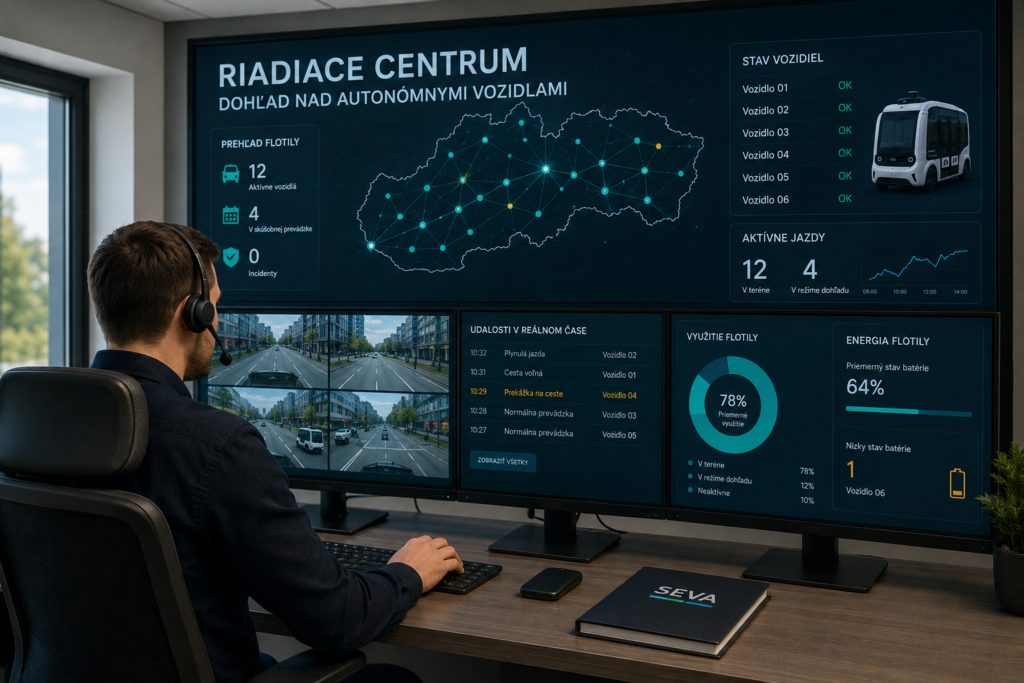
The amendment introduces nine new terms into the law. The operational area of use refers to the geographic, traffic, temporal, weather, and environmental conditions under which the system is to operate. Minimum safe operating conditions are conditions under which operation does not endanger life, health, property, or traffic safety. A control center is a facility providing continuous technical supervision.
The license holder must define the operational area, establish and continuously operate the control center, maintain liability insurance, report changes within 15 days, and make data available to the ministry. The vehicle must be equipped with a recording system, and every accident must be reported immediately to both the Ministry and the police.
The monitoring operator must be a person over 18 years of age who is employed by the license holder, has held a driver’s license for at least three years, and has completed training provided by the manufacturer. Therefore, a subcontracting or agency arrangement is likely not permitted. Supervision may be conducted exclusively from within the territory of the Slovak Republic and from a control center, which in practice rules out a shared European control center as well as nighttime coverage from a different time zone.
Current Status of the Process
The government’s proposal was submitted to the National Council on May 7, 2026, and passed its first reading on June 3, 2026. The committee deadlines are September 11 and 14; the fall session begins on September 15. This leaves roughly six weeks between potential approval and the proposed effective date of November 1—and that’s only if the bill is debated right at the start of the session. The effective date is therefore a rather optimistic scenario. With the implementing decree and the list of road sections, the first license can realistically be expected no sooner than 2027. The international context is moving faster. In June 2026, the United Nations World Forum for Harmonization of Vehicle Regulations (UNECE WP.29) adopted UN Regulation No. 185, the first global framework for the approval of automated driving systems. Two weeks earlier, on June 8, eighteen member states—including Germany, Hungary, the Czech Republic, Austria, and Poland—signed a declaration of intent to create a cross-border testing environment for autonomous vehicles. Slovakia is not among the signatories.
| FIVE THINGS WORTH NOTING IN THE TEXT OF THE AMENDMENT 1. The entry barrier is closed to operators. Only a holder of a test operation permit may apply for a license, and according to the current wording, this can only be a manufacturer or a manufacturer’s representative. A transportation service operator thus cannot enter the chain in its own name. The solution is either to obtain the status of a manufacturer’s representative or to propose an amendment during the second reading. 2. The bill does not require proof of type approval anywhere. You will not find it listed among the requirements for a license application. In the compatibility clause, the government even states that the subject matter of the proposal is not regulated by EU secondary legislation, even though Regulation 2022/1426 applies to automated driving systems. 3. The implementing decree is currently an empty shell. The draft attached to the parliamentary document contains five headings without a single provision, even though it is supposed to specify the requirements for the control center and data retention periods—parameters on which operating costs depend. 4. Two sections appear to contradict each other. According to one, the operator may monitor multiple vehicles simultaneously; according to the other, the operator may control only one vehicle at a time. Thus, passive monitoring of the fleet is permitted, but active control is limited to a single vehicle. 5. The ban on the transport of hazardous materials is worded more broadly than was apparently intended. It applies to “automated” vehicles, not “fully automated” ones, so a literal interpretation would also cover Level 3 vehicles, which currently operate with a driver behind the wheel. |
The text reflects the status of the legislative process as of the end of August 2026 and is based on the government’s draft following the first reading. References to individual provisions are references to the proposed wording, which is not yet law and may still change during the second reading. This is not a binding legal opinion nor a substitute for a lawyer’s assessment of a specific project.