
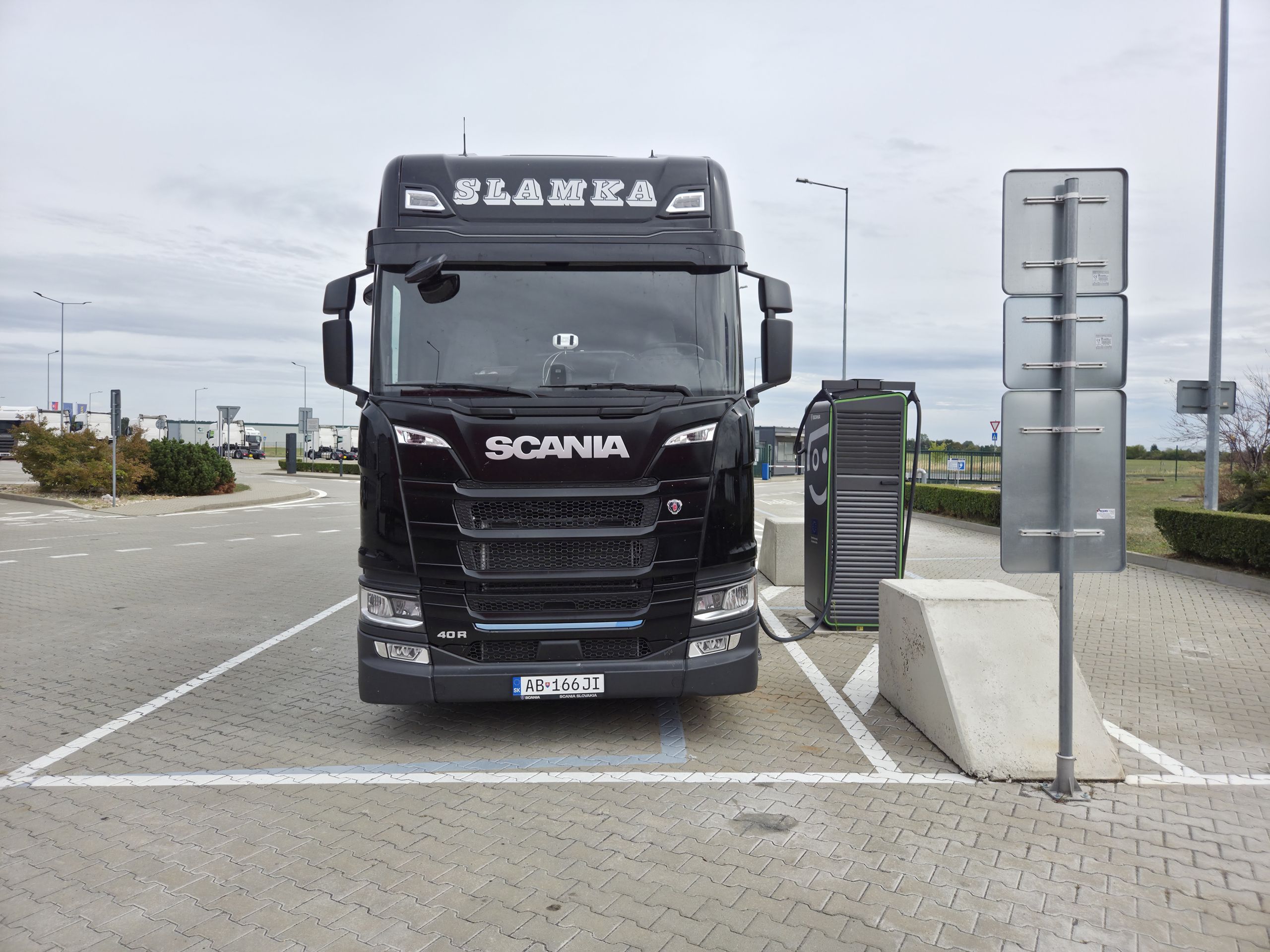
The electrification of freight transport need not be limited to urban delivery or short routes. A practical example from Slovakia shows that a battery-electric tractor can also be used for regular transport with a daily mileage of nearly 500 kilometers. The transportation company Jozef Slamka International Transport uses a Scania 40 R on the route between Bratislava and Gbeľany near Žilina. It transports 14 to 15 metric tons of cargo every day. Operations are made possible by a combination of overnight charging at the company’s own depot and high-power charging stations in the manufacturer’s service network.
A Regular Route Instead of a Test Run
The key difference from a one-time technology demonstration is that the electric tractor performs daily transport tasks. Since its deployment, the vehicle has completed more than twenty trips to date and has covered a total of nearly 8,000 kilometers. These are initial operational experiences, not a long-term test of the vehicle’s total cost of ownership or service life. However, even these figures show that the carrier has successfully integrated the electric powertrain into its standard operations.
According to the owner of the transportation company, the request to switch to electric propulsion came from a customer. Before introducing the electric tractor, the carrier tested the technology’s capabilities using a demonstration vehicle. This reduced the risk that the new vehicle would not be suitable for a specific route, cargo weight, or the driver’s work schedule.
“When our customer requested that we deploy an electric vehicle on this route, we took advantage of Scania’s offer. First, thanks to the demonstration vehicle, we were able to verify in practice that the electric tractor could indeed handle this route and that we could integrate it into our regular operations,” says company owner Jozef Slamka.
Charging That Accommodates Driver Breaks
The basis for successful deployment is not just battery capacity, but the availability of energy at the right time and in the right place. Scania therefore uses its own service centers in Senec and Žilina, where it operates 400-kW charging stations. These locations are designed for freight transport: a tractor-trailer can stop to charge even with the trailer attached, without having to reposition the vehicle.
According to the manufacturer, an electric Scania typically arrives at the charging station with a battery charge level of approximately 50 percent. During the driver’s mandatory break of about one hour, the vehicle recharges enough energy to continue the route. At night, it charges at the carrier’s own depot, where the battery is recharged with an additional approximately 210 kWh. In this way, charging becomes part of the operational schedule, rather than a separate, unplanned stop.

For transportation companies, this model is particularly important for routes with a repetitive schedule. If work breaks and charging locations can be coordinated, the electric vehicle can perform its transport tasks without the need to significantly change the organization of the service. However, the result always depends on the specific route, payload, weather, available charger capacity, and the customer’s time requirements.
Scania 40 R: 535 kWh battery and average consumption of 104.2 kWh/100 km
The vehicle in use is a two-axle Scania 40 R electric tractor. Its electric powertrain has an output of 400 kW and uses a four-speed transmission. The batteries, located on either side of the chassis, have a total capacity of 535 kWh. In a press release, Scania states that average energy consumption in daily operations to date has reached 104.2 kWh per 100 kilometers.
This consumption figure is most meaningful in the context of the vehicle’s actual operational use: regularly transporting 14 to 15 metric tons of cargo on a route with a daily mileage of nearly 500 kilometers. However, it cannot automatically be considered a universal value for every electric truck or other freight route. Energy consumption in heavy-duty vehicles is significantly influenced by the weight of the truck-trailer combination, speed, route profile, and external conditions.
At the same time, it is important to distinguish between the power of the drive system itself and the power of the charging station. In this case, Scania specifies 400 kW for the electric drive system and 400 kW for charging stations at service centers. However, the same numerical value refers to two different technical quantities and does not in itself mean that the vehicle receives the station’s maximum power throughout the entire charging process.
Truck Infrastructure Is More Than Just Charger Power
When electrifying heavy-duty freight transport, it is not enough to simply adopt the charging model used for electric passenger cars. The station must be accessible to long truck-trailer combinations, be of sufficient size, and allow for safe passage and stopping. From a business perspective, it must also guarantee practical usability for carriers at locations where vehicles need a break or are returning to the depot.
That is precisely why it is interesting that Scania is also integrating its service network into the charging infrastructure. Service centers can thus fulfill an additional function within the electric freight transport ecosystem, in addition to vehicle maintenance and support. In this case, they help create an operational corridor between Bratislava and the Žilina area without the carrier having to build the entire public charging infrastructure on its own.
“An electric truck alone is not enough. The carrier must be confident that it can reliably charge the vehicle at locations and times that align with its daily operations. The example of Jozef Slamka International Transport shows how the integration of the vehicle, depot charging, and Scania’s charging infrastructure can make it possible to electrify even a regular route covering nearly 500 kilometers a day,” says Lukáš Martinů, e-mobility Sales Manager at Scania CER.
Connecting the Manufacturer, the Carrier, and Energy Services
In addition to electric trucks themselves, Scania is developing solutions for depot charging and semi-public infrastructure. It also involves external partners, including GreenWay, in the development of charging solutions. At the same time, it offers drivers and fleet operators the Scania Charging Access service, which is designed to make charging easier while on the road.
The digital services My Scania, Scania Fleet, and Scania Driver allow users to monitor operational data and use it for route planning. With electric trucks, data on energy consumption and charging management take on particular importance: they help assess whether a vehicle is suitable for a specific route and how to effectively integrate it into the fleet.
What This Example Means for the Electrification of Freight Transport
The case of Jozef Slamka International Transport illustrates a practical principle that will also be important for other Slovak carriers: the selection of an electric truck must go hand in hand with charging planning. Whether the technology works in commercial operation is determined not only by the stated range but by a whole set of conditions—the specific route, the weight of the cargo being transported, the driver’s breaks, the depot’s infrastructure, and the reliability of charging stations.
This example alone does not yet answer questions regarding acquisition costs, total cost of ownership, or economic return on investment. The press release does not provide this data. However, it offers valuable insight from everyday operations in Slovakia: with properly configured infrastructure and logistics, an electric tractor-trailer can cover nearly 500 kilometers per day even while transporting a double-digit number of metric tons of cargo.
From the perspective of electromobility development, it is equally important that this solution did not arise as an isolated investment in a single vehicle. It brings together the needs of the freight customer, the carrier’s willingness to test electric propulsion, and the manufacturer’s charging support. It is precisely this kind of collaboration that can determine which regular freight routes will be the first to be electrified.
For Jozef Slamka, the electric tractor also holds symbolic value. In 1998, Scania became the first foreign-brand truck in the company, and today it represents another technological leap forward. “For me, the electric tractor also shows that we want to keep up with the times and move the company forward,” adds Jozef Slamka.
Source: Scania Slovakia press release, November 5, 2026. Original press release from Scania. Photos: Scania.