
Physics, operational economics, and the logic of deployment all point in the same direction. Autonomy and electrification are not competing paths.
Electromobility and autonomous driving are often described as two separate competitions. In reality, they are two layers of the same structure, and the underlying layer is electric. A peer-reviewed study in the *World Electric Vehicle Journal* from 2025 puts it bluntly: electrification is a structural prerequisite for autonomy.
Power Supply and Safety Redundancy
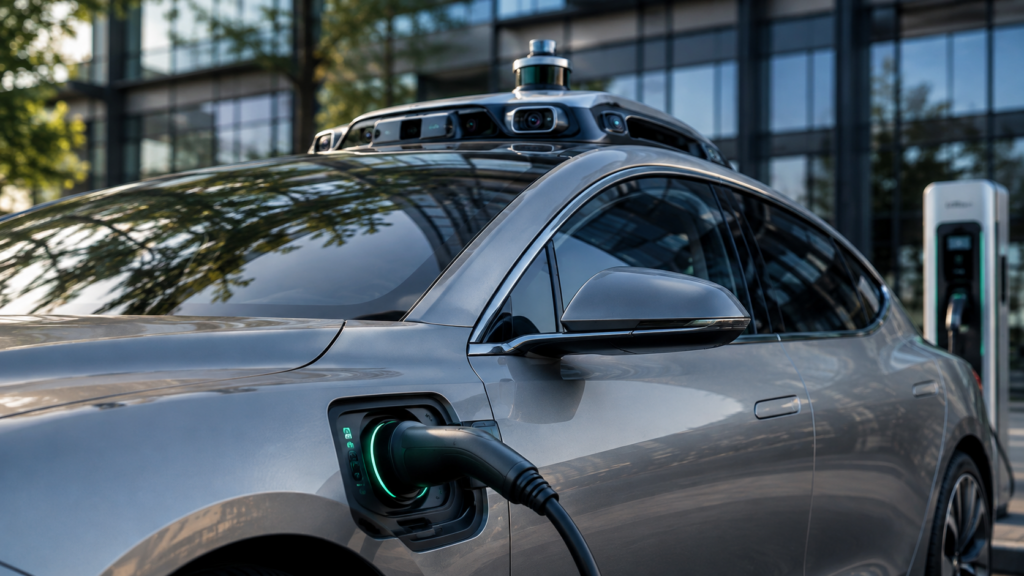
An autonomous driving system is energy-intensive and sensitive to power quality. It requires power to process sensor data in real time, to operate the sensors themselves, and for cooling.
In an electric vehicle, the traction battery, operating at 400 to 800 volts, functions as a large power bank. A bidirectional isolated converter uses this battery to generate a stable 12- to 48-volt on-board power supply for cameras, LiDARs, radars, and domain computers, with an efficiency of over 90 percent and ripple in the range of a few to tens of millivolts. The voltage deviation remains within ±2 percent, which meets the Class IV limits of the ISO 16750-2 standard for safety-critical electronics.
In a gasoline-powered car, low voltage is generated by the alternator and backed up by a 12-volt lead-acid battery. Interference here is on the order of a few volts—that is, two orders of magnitude higher. The battery is designed for short starts. If it is to be deeply discharged in order to keep the sensors powered while the engine is off, its capacity will drop by 20 to 30 percent after just a few dozen cycles.
Added to this is functional safety. The ISO 26262 standard requires redundant power supplies for critical systems at the most stringent ASIL-D level: if one power source fails, the other must take over without any degradation in performance. The electric platform has two independent power sources built directly into its architecture: a high-voltage converter and an auxiliary 12-volt battery. The internal combustion engine relies on a single alternator circuit, which does not meet ASIL-D requirements without significant redesign.
Heat and Updates
Computing platforms for autonomous driving consume approximately 80 to 120 watts per unit. An electric vehicle already has liquid cooling for the battery, motor, and inverter, and the autonomous computer can be connected to it. Such a circuit dissipates over 300 watts per control node at a coolant temperature of around 65 °C. Air-cooled units in internal combustion engine cars typically draw up to 50 watts, so the computing unit would require its own cooling system.
The autonomous software is continuously improving, which means regular remote updates. An electric vehicle is continuously powered and remains connected while charging. A gasoline-powered car requires the engine to be running—or at least the ignition to be on—during extended parking to prevent the 12-volt battery from discharging. Starting the engine at night in an underground garage to perform an update violates noise and emissions regulations in many cities, and some vehicles do not even allow this for safety reasons.
Controls and Operational Data
An electric powertrain delivers torque instantly, and most electric vehicles use a single-speed transmission. This provides the autonomous system with smooth, jerk-free response—eliminating the jerks associated with gear shifts—which improves trajectory tracking accuracy.
Autonomous driving systems learn from real-world driving data, and electric vehicles come standard with a telematics unit, so feedback from the fleet flows to the cloud without any additional modifications. Older internal-combustion models often lack this feature, and retrofitting it increases both costs and complexity.
Operating Economics
A vehicle in an autonomous fleet covers many times more kilometers per year than a private car. It is precisely with high mileage that the lower energy cost per kilometer and the reduced maintenance requirements of the electric powertrain become apparent: fewer moving parts, no oil changes, and regenerative braking. The largest cost item for a taxi service—the driver—is also eliminated, further shifting the balance toward energy and maintenance costs.
The main objection to electric mobility is the time spent charging. With a driverless vehicle, this issue disappears, since no one has to wait at the charging station. The vehicle schedules its charging for a time slot when it has no fare. Furthermore, the fleet operator handles charging in one central location—at its own depot—rather than at a hundred different locations depending on where a hundred drivers live.
What Does This Mean for Slovakia
The overwhelming majority of robotaxi fleets currently operating in the U.S. and Asia—or preparing to launch in Europe—are battery-powered. These are independent decisions made by various companies in different regulatory environments, yet they all lead to the same conclusion. The charging infrastructure, grid capacity, and smart energy management systems we are building today for personal electric mobility are the very same infrastructure that autonomous fleets will need. Investing in electrification, therefore, is not a bet on a single technology, but rather laying the groundwork for the entire next wave.
| Technical data are based on a review study by Gao, J.; Qiu, Y.; Chen, Z. (2025): Systemic Integration of EV and Autonomous Driving Technologies: A Study of China’s Intelligent Mobility Transition. World Electric Vehicle Journal, 16(10), 574. The values provided are approximate and depend on the specific vehicle architecture. |