
Electromobility isn’t just about replacing an internal combustion engine with an electric powertrain. It changes the very essence of the car, its connection to the energy sector, and the way the vehicle communicates with the driver, the infrastructure, and its surroundings. Patrik Križanský, director of SEVA, explains why the car is becoming a digital and energy platform.
Electromobility is often simplified to the replacement of gasoline or diesel with electricity. However, this view captures only one part of a much broader technological shift. Alongside the electrification of transportation, the digitization of cars, the energy sector, infrastructure, and the services surrounding mobility is also underway.
A modern electric vehicle is no longer just a mechanical product with an electric motor and a battery. It is a comprehensive digital platform that relies on software, data, cloud services, and a constant internet connection. The vehicle can communicate with the driver, the charging infrastructure, service providers, fleet operators, and the energy grid.
Patrik Križanský, director of the Slovak Association for Electromobility and vice president of E-Mobility Europe, explains in a SEVA Policy Talks presentation that electrification, the energy transition, and digitalization are not three separate trends. They are interconnected parts of a single technological revolution.
A mechanical product is becoming a software platform
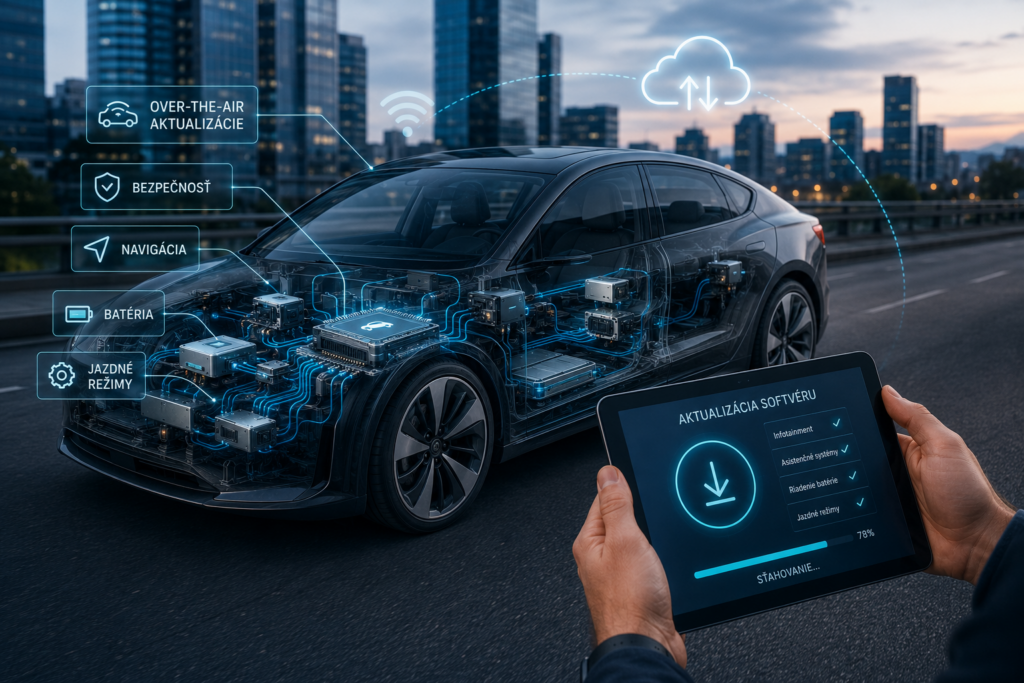
The traditional automobile was primarily the result of mechanical engineering. Its characteristics were largely determined by the engine, transmission, chassis, and mechanical components. Once delivered to the customer, the product remained virtually unchanged for most of its lifespan.
In a modern electric vehicle, software is becoming increasingly important. It controls the drive system, energy consumption, charging, battery temperature, safety systems, navigation, comfort, and the vehicle’s communication with the outside environment. Many features can be updated or expanded even after the car is purchased, without a physical visit to a service center.
As a result, the car is beginning to resemble a smartphone or a computer. Customers are not just buying a finished mechanical product, but a platform that can continue to evolve over its lifetime, gain new features, and adapt to the user’s needs.
At the same time, this shift is transferring part of the car’s value from traditional mechanical components to software, chips, data, battery systems, and digital services.
The Car Connects to the Energy Grid
An electric vehicle is a means of transportation, but it is also a large mobile energy storage unit. Its battery has a significantly higher capacity than a typical home storage system, and the vehicle remains parked for most of the day.
If the system knows the departure time, the desired range, and current grid conditions, it can schedule charging for a time when electricity is cheaper or when there is sufficient energy available on the grid. The vehicle will be charged in time, but it does not need to start drawing electricity immediately after being plugged in.
Smart charging management can reduce the driver’s costs, limit peak demand, and help make better use of electricity from renewable sources. As the number of vehicles increases, electric vehicles can become a significant tool for energy flexibility.
The next step will be bidirectional charging. Vehicle-to-home and vehicle-to-grid technologies will enable an electric vehicle to supply some of its energy to a home, building, or the power grid when needed. The vehicle will thus not only be an energy consumer but also an active part of the energy system.
Modern charging wouldn’t work without digitalization
The charging station itself is only one part of the entire ecosystem. Behind the simple connection of the vehicle lie information systems, data communication, user identification, payments, roaming, billing, remote diagnostics, and management of available power.
Digitization allows the driver to locate a charging station, check its availability, find out the price, start charging, and pay for the service. It also allows the operator to monitor the station’s status, troubleshoot issues remotely, regulate power output, and use the electrical connection more efficiently.
At the same time, the interconnection of the vehicle, the charger, and the power grid opens the door to automated services. In the future, a car may be able to independently locate a suitable charging station, reserve power, verify the user’s identity, and complete payment without any further intervention from the driver.
Data Is Changing How Vehicles Are Used
The digital car generates and processes large amounts of data. Information on consumption, battery status, driving style, location, operating conditions, or technical condition can improve service, safety, and energy management.
In corporate fleets, data enables more precise planning of routes, charging, and the utilization of individual vehicles. Service departments can detect a problem before it causes the vehicle to break down. Charging infrastructure operators can better estimate future demand and adjust available capacity accordingly.
At the same time, however, the importance of cybersecurity, privacy protection, and clear rules for data access is growing. A vehicle connected to the internet must be protected just as rigorously as other critical digital systems.
The question is therefore no longer just what data a car generates, but also who owns it, who can use it, and under what conditions.
Automakers and Their Suppliers Are Changing
The transformation of the car is fundamentally changing the entire automotive industry. The competencies that ensured success in the past may not be enough in the era of electric propulsion, software-defined vehicles, and data services.
Manufacturers must master the development of battery systems, power electronics, software, sensors, chips, digital architecture, and cybersecurity. Suppliers must seek out new products and services, as some traditional internal combustion engine components will gradually become obsolete.
At the same time, automakers are entering areas that, until recently, belonged to energy, technology, or telecommunications companies. Vehicle manufacturers, energy companies, charging network operators, software companies, data platforms, and digital service providers are all converging in a single market.
Competition, therefore, is no longer limited to engine performance, chassis, or design. The user experience, software quality, speed of updates, charging options, energy management, and the vehicle’s integration with other services are also decisive factors.
An Opportunity for Slovakia
This shift is of extraordinary significance for Slovakia. Our economy is heavily tied to the automotive industry, which is undergoing its greatest technological transformation in decades.
It is therefore not enough to simply maintain vehicle production. Slovakia must build expertise in areas where future added value will be generated: software development, battery technologies, electronics, energy, data analytics, automation, and cybersecurity.
We need to strengthen the automotive industry’s connections with the energy sector, technology companies, universities, and research institutions. Equally important is educating and preparing people for professions that combine knowledge from multiple sectors.
Electromobility is not merely a change in propulsion systems. It is a gateway to a world where mobility, energy, and digital technologies converge.
The result will not merely be a quieter, cleaner, and more efficient vehicle. The way cars are manufactured, used, charged, serviced, and owned is changing. The car is gradually becoming a digital and energy platform that can bring new services, new business models, and new opportunities for the entire economic ecosystem.