
Europe does not have a Visegrad problem because the region produces too many cars. It has one because the region still produces value as if the combustion era will last longer than markets allow. Poland, Czechia, Slovakia and Hungary built a large part of their economic model on automotive manufacturing. That model delivered growth, exports and industrial jobs. It also created a dangerous habit of treating continuity as strategy.
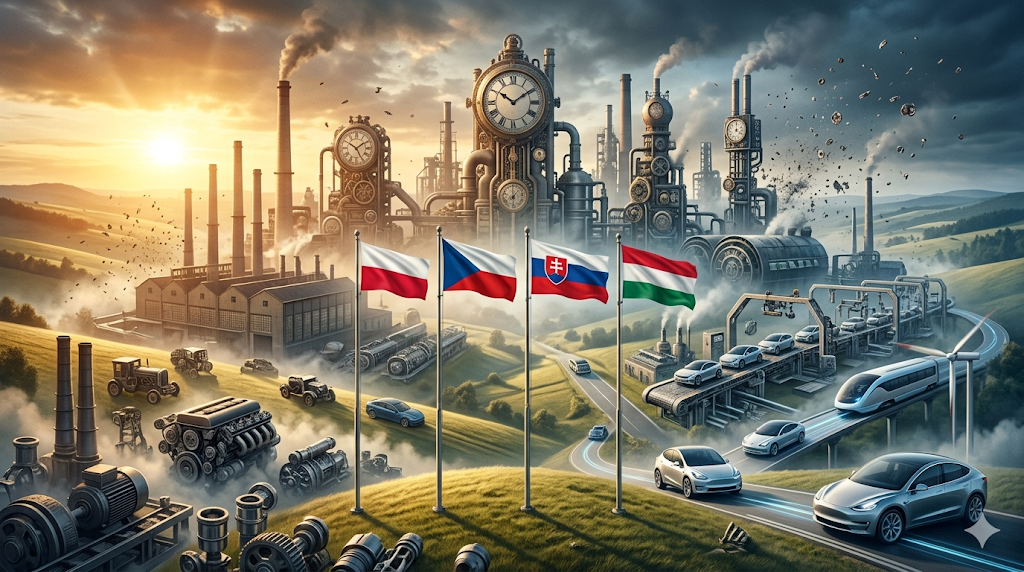
The market is no longer offering that comfort. Sales of combustion vehicles peaked globally in 2017 and have been eroding since then, while electric vehicles continue to take their place. This is not mainly a climate story anymore. It is a transfer of value. In the next automotive cycle, the centre of gravity moves away from engines and gearboxes and toward batteries, power electronics, chips, software, data, charging and electricity itself. Regions that remain strong only in final assembly will not disappear overnight, but they will keep a thinner share of the margin and a weaker say over the next round of investment.
That is precisely why the Visegrad debate still feels oddly outdated. It often sounds as if the region were deciding whether to join the transition at all, when in reality it is already inside it, only on unequal terms. Factories are changing. Supply chains are changing. Product planning is changing. What remains undecided is whether the region will capture more of the new value or defend the old logic until that value moves elsewhere.
The car is becoming a digital-electric product
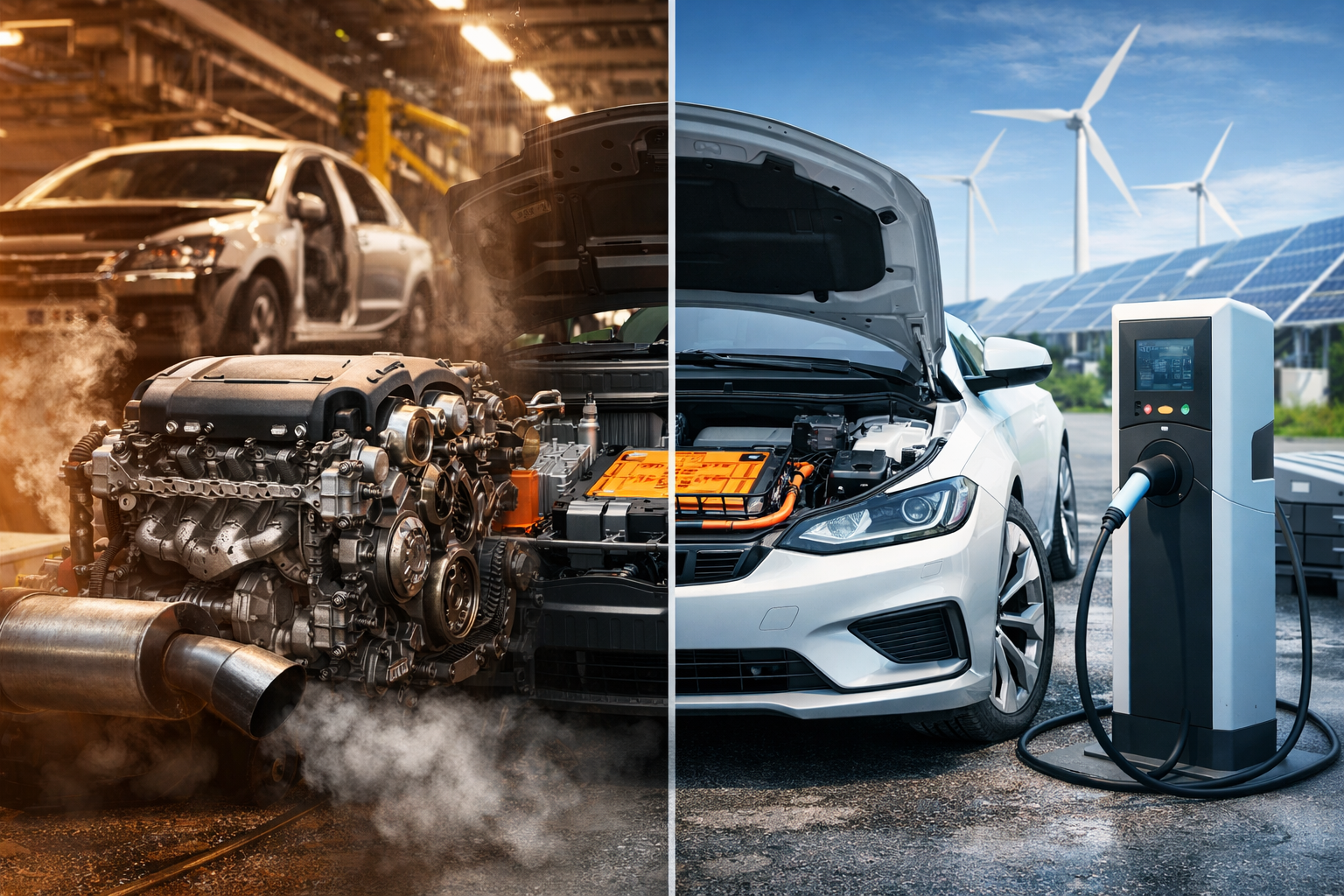
This is not just a drivetrain swap. The car itself is changing character. It is becoming a digital-electric product, increasingly defined by battery systems, software architecture, connectivity, assistance functions and the ability to improve performance over time. A region that keeps talking about cars as if value still sat mainly in the mechanical core will misread where competitiveness is going.
China did not make that mistake. It treated electromobility as industrial policy long before Europe was ready to do the same. That decision now shows up in battery scale, in development speed and in the quality of digital integration. European manufacturers, by contrast, spent too long protecting the profitability of combustion vehicles, postponing affordable electric models and lobbying for a slower pace of change. The result is visible in batteries, software and cost pressure. Europe still has industrial depth, but it has less room for hesitation than its politics suggests.
A region extremely exposed to change
This matters most in Visegrad because the region is unusually exposed. Slovakia, Czechia and Hungary are 1st, 2nd and 3rd in the world in vehicle production per capita, while Poland is 7th. Automotive is not just another industry here. In Slovakia it represents almost half of industrial production. In Czechia roughly a third. In Poland it is lower, but still critical. The region has therefore been exceptionally good at producing vehicles, while remaining much less successful at anchoring strategic decision-making, high-value research or a thick layer of domestic innovation around them.
The imbalance is visible country by country. Hungary is currently the strongest battery producer in the region, with around 90 GWh already in place and a goal of 200 GWh by 2030. Poland is just behind, with around 65 GWh and more than 100 GWh listed or planned. Slovakia aims for around 20 GWh by 2026 or 2027 through the InoBat-Gotion project. Czechia, despite its strong automotive base, still has no firm battery project and has struggled to turn ambition into execution. This is a real regional map of the future, and it already has winners, late movers and unresolved bets.
Yet even that comparison needs a second look. Hungary and Poland have largely pursued classical foreign direct investment models, good for scale and jobs, weaker in technology spillover. Slovakia at least has a chance to build something more mixed through a joint-venture model with a research and development component. Czechia has deeper engineering capacity than its current battery position suggests, but it has lost time. The region is therefore not short of industrial assets. It is short of alignment.
Exporting the future, importing the past
Another weakness is even more uncomfortable. Visegrad exports the future in factories while importing the past onto its roads. For two decades the region has absorbed large volumes of used fossil vehicles from Western Europe. That second-hand flow helped preserve low-cost mobility, but it also locked in old fleets, delayed domestic electrification and widened the gap between what these economies build and what their own consumers use. If a region produces electric cars but keeps buying old diesel and petrol cars for itself, it is undermining its own transition from both ends.
That is why Slovakia cannot be the whole story, but it remains a useful warning. Its factories are adapting faster than its domestic market. Hungary has moved hardest on battery scale. Poland has built both battery capacity and more serious incentives. Czechia remains industrially strong but strategically hesitant. None of these positions is secure. Battery projects now compete not only on subsidies, but on electricity price, grid reliability, permitting speed and skilled labour. On that score, the region has a problem. Hungary and Slovakia are among the EU countries with the highest industrial electricity prices. Wealthier Western states can also spend more aggressively under looser state-aid rules. Portugal did not beat Bratislava for Volkswagen’s small EV project by accident.
Demand will decide as much as factories
The domestic market matters just as much. In late 2025, Slovakia was near the bottom of the EU in zero-emission registrations, with Poland and Czechia only slightly above it and Hungary still below the European mainstream. Affordability remains the main barrier. So does unfamiliarity. That makes the next wave of smaller electric models and the first serious wave of used EVs especially important. It also means communication must improve. Not marketing slogans, not culture-war language, not panic about bans. People need a practical explanation of costs, charging, resale value and everyday use. They need reasons to test the product rather than reasons to fear it.
Sentiment is not an industrial strategy
Visegrad will not keep its place in European automotive by demanding a slower funeral for the internal-combustion engine. It will keep that place only by moving faster into batteries, software, power, infrastructure and skills than the old engine business declines. That is a harder agenda than nostalgia, but it is the only one with industrial content.
Supported by

Projekt spolufinancujú vlády Česka, Maďarska, Poľska a Slovenska prostredníctvom vyšehradských grantov z Medzinárodného vyšehradského fondu. Poslaním fondu je podporovať myšlienky udržateľnej regionálnej spolupráce v strednej Európe. www.visegradfund.org