
The Slovak Association for Electromobility (SEVA) provides a detailed analytical overview of the state of public charging infrastructure in Slovakia as of March 31, 2026. The data show that public infrastructure is growing not only in terms of the number of charging points or locations, but especially in terms of total capacity. While the number of public charging points has increased approximately fourfold since 2020, their total capacity has grown more than sevenfold. The most significant shift has occurred in the ultra-fast charging segment, which reduces the time needed to charge a vehicle and significantly enhances convenience, especially when traveling long distances.
“It’s not just new stations that are appearing on the map, but more powerful technologies. This is very important from the perspective of the real-world use of electric vehicles, because it is precisely this higher power output that determines whether public charging functions not only as a supplementary service but also as a full-fledged component of comfortable travel. Data today shows that Slovakia is moving in the right direction in this regard,” says Martin Jelenek, data analyst at SEVA.
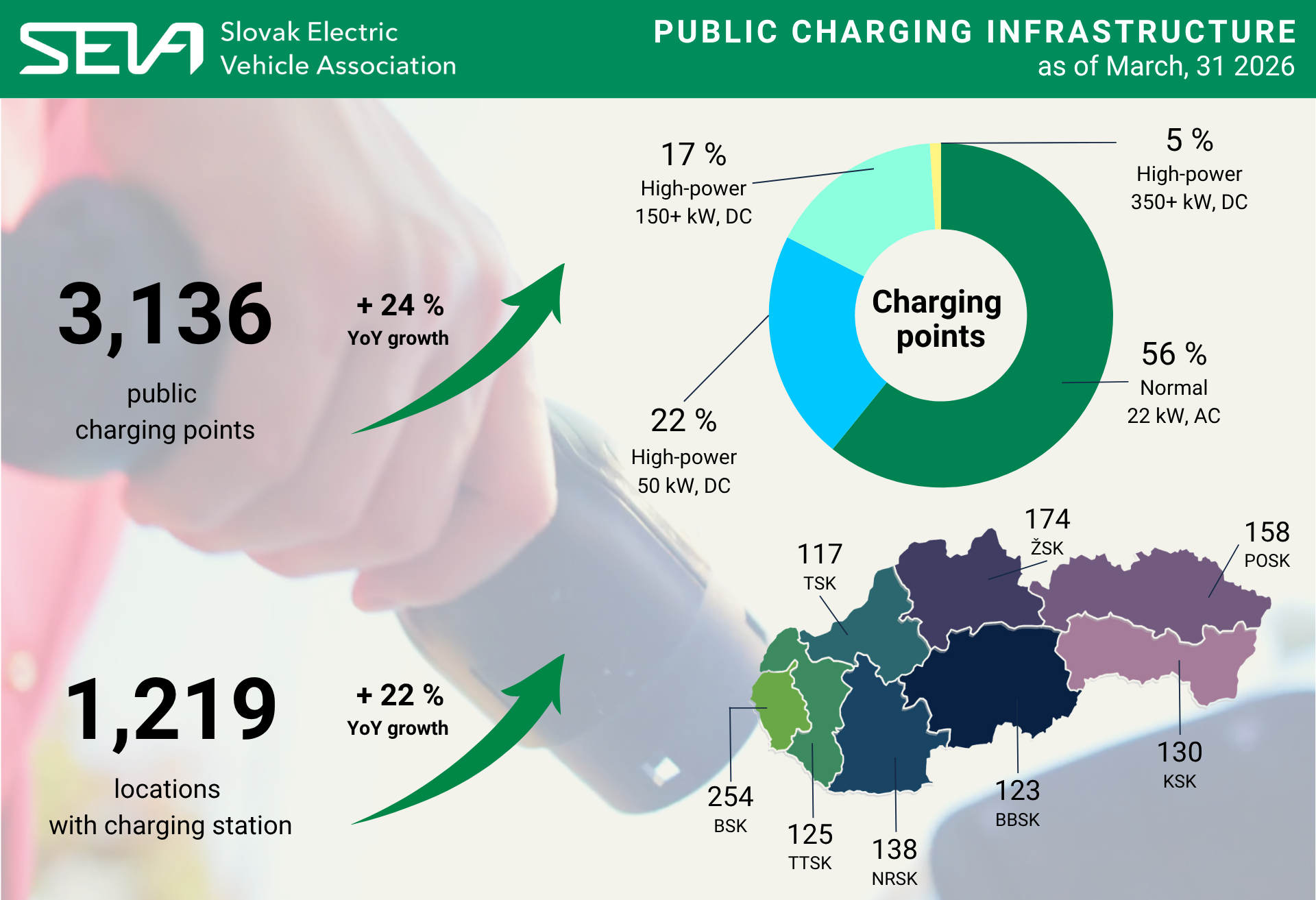
The most significant shift has occurred in the ultra-fast charging segment. The number of public charging points with 350 kW capacity rose from 28 (at the end of 2024) to 148 by the end of March 2026. This represents a more than fivefold increase over approximately 15 months. This development directly translates into greater user comfort when traveling long distances, as reducing the time needed to charge a vehicle is one of the most tangible practical benefits of infrastructure development for drivers.
A New Perspective on the Geographic Distribution of Chargers
New SEVA data debunks the stereotype that high-quality charging infrastructure is concentrated only in the western part of the country. In terms of the ratio between the number of battery-electric passenger vehicles on the road and the number of public charging points, the Prešov Region comes out on top. There are 388 public charging points for every 2,270 battery-electric passenger vehicles, meaning just 5.85 electric vehicles per point. By comparison, the national average is 8.64 electric vehicles per public charging point. At the opposite end of the spectrum is the Bratislava Region, where the high number of electric vehicles places the greatest strain on the infrastructure—there are 803 public charging points for 9,660 passenger BEVs, or approximately 12 electric vehicles per point, which is significantly above the national average.
“At SEVA, we took the time to examine the data we’ve been collecting over the long term in great detail and from an analytical perspective. It is precisely this perspective that allowed us to uncover interesting correlations that aren’t immediately apparent—for example, that some regions already offer not just basic coverage, but technologically very advanced infrastructure,” says SEVA Director Patrik Križanský. In some parts of Slovakia, high-performance charging suitable for intercity use already dominates—in the Zlaté Moravce district, 23 out of 31 charging points are fast and ultra-fast DC charging (74.2%), and in the Zvolen district, it’s 47 out of 83 points, meaning more than half of the network, which suggests that these regions, for example, are ready for convenient charging even during longer trips. “It is precisely in districts like Zlaté Moravce or Zvolen that we can see that the quality of infrastructure cannot be assessed solely based on absolute numbers. It is also important to monitor the network’s power structure. If a region has a high proportion of DC points, this indicates greater readiness for transit, business travel, and more intensive daily use. This is a very important signal from the perspective of further market development,” adds Križanský.
The Martin district is one of the most interesting examples of well-developed infrastructure outside the largest urban centers. There are 365 registered battery-electric passenger vehicles, and drivers have access to 94 public charging points across 41 locations. This means there are only 3.9 electric vehicles per charging point. Dolný Kubín shows an even more favorable ratio, with 162 electric vehicles for 52 public charging points—that is, 3.1 vehicles per point. In Poprad, the ratio is 3.4, and in Zvolen, 3.9 electric vehicles per point. The data thus shows that a high-quality public charging network is not only emerging where the largest number of electric vehicles are currently found, but also in transit, tourist, and regional centers that are preparing in advance for further market growth.
“When we look at Slovakia in more detail, Martin is definitely no coincidence. We see that several districts outside Bratislava have public charging infrastructure very well established, and in some metrics even better than the strongest economic centers. This is an important signal that Slovakia no longer has a problem solely with the number of chargers as such, but rather with where the vehicle fleet is growing fastest and how the network can adapt to this,” notes Martin Jelenek.
Charging convenience and service availability
SEVA points out that network development should be evaluated not only based on technical parameters but also on user comfort. A detailed database of chargers shows that nearly 85% of public locations operate 24/7, and approximately 84% allow one-time ad hoc charging without the need for registration. This increases service availability even for people who do not use a specific network regularly.
“If we want to get closer to a standard that drivers will consider natural, it’s not enough to just build new chargers. It is equally important that charging be intuitive, simple, and free of unnecessary barriers. This means 24-hour availability, the option for ad hoc charging, as well as clear and convenient payment methods,” states the director of SEVA.
Slovakia’s charging infrastructure in numbers
As of the end of the first quarter of 2026, there were 3,136 public charging points registered in Slovakia across 1,219 locations. Of the total, 1,756 were AC points, 686 were DC points with a power output of 25 to 150 kW, 546 were in the 150 to 350 kW category, and 148 had a power output of 350 kW. The total capacity of the public infrastructure reached 206.6 MW. The data also shows that the network’s modernization continues with more technologically advanced parameters —over 60% DC locations, for example, also support charging for 800 V architecture, which will become increasingly important with the arrival of new electric vehicle models and will allow a vehicle’s battery to be charged from 10% to 80% in 12–20 minutes.
Public charging infrastructure in Slovakia is gradually transforming from a marginal supplementary network into a viable ecosystem capable of supporting further growth in electric mobility. The latest analysis shows that Slovakia now not only has more chargers than it did a few years ago, but also a significantly stronger and more technologically advanced network. This will be the deciding factor in how quickly electric mobility becomes a natural part of transportation in regions and on major highways across the country.